
The operational data platform for enterprise AI
Occam generates the core of your operational system from one model of your business. It also generates The Shield, which checks every AI agent action against your business rules before anything is committed.
Greater flexibility. Less complexity. Total integrity.
Define the entities, relationships and rules of your business.

Core code across databases, applications, screens, ETL, APIs and MCP connectivity, with no AI in the generation.
The Shield checks every agent action against business rules. Every proposal, refusal and commit is logged.
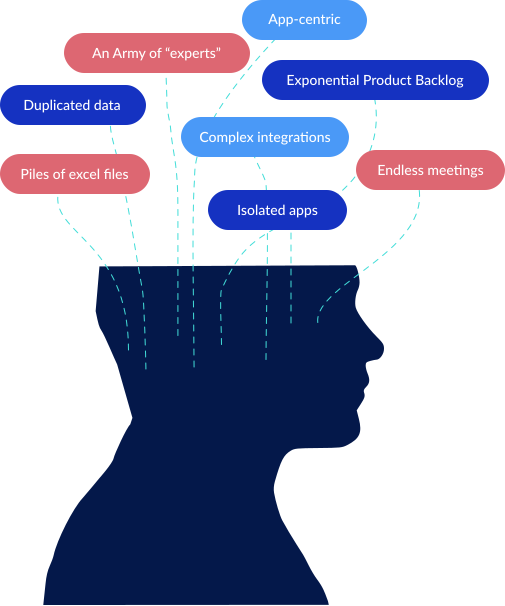
To do real work, AI needs your data, the meaning behind it and a safe way to act. Today that meaning is scattered across databases, applications and spreadsheets, so AI can’t reason across any process that spans more than one system. And no one lets a probabilistic system act directly on the systems that run the business.
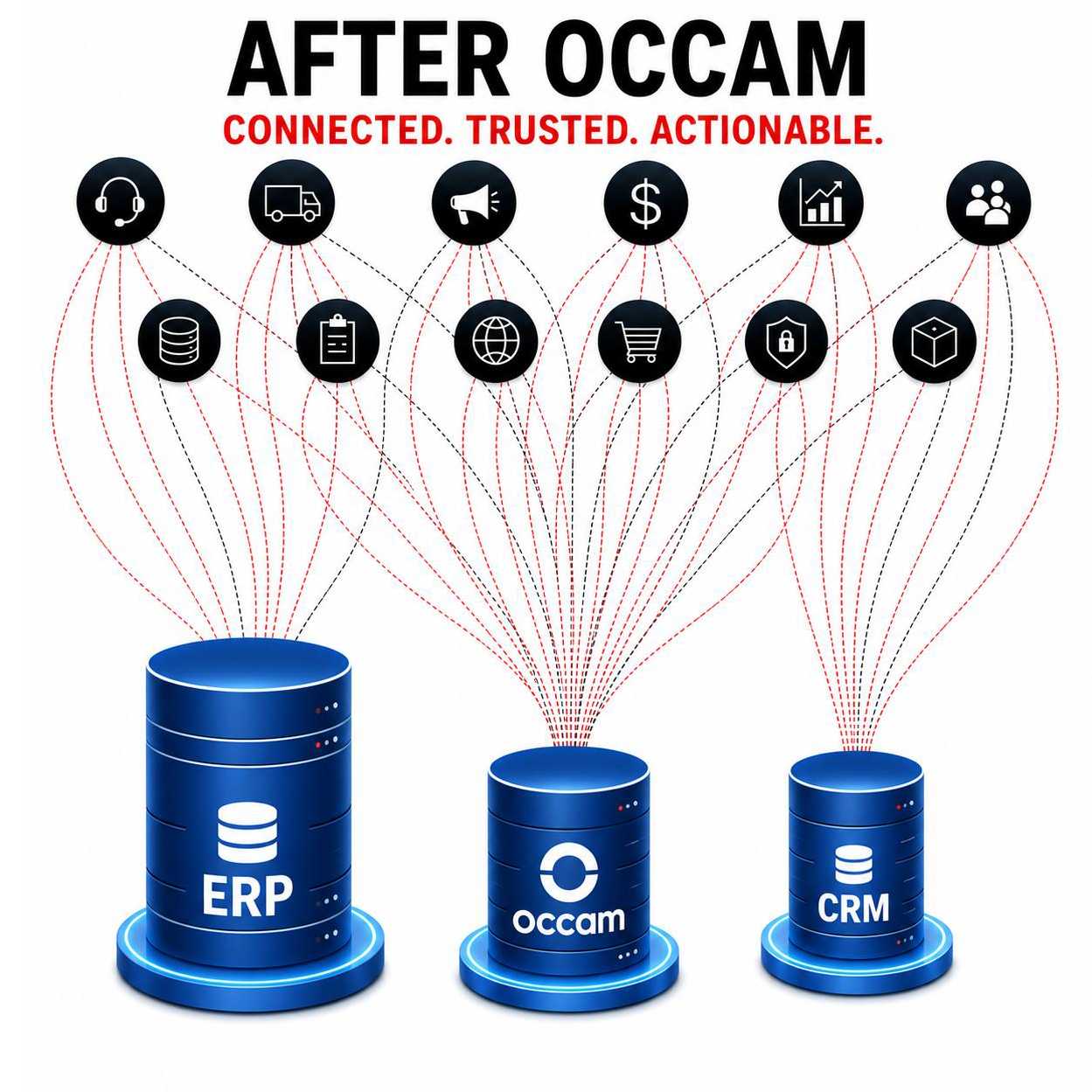
Occam brings your data and its rules into one model, generates the operational system from it, and gives AI agents one governed place to act.
One version of the truth to read from. One governed place to act through. Nothing in your operational systems has to change.
Data unified across three major systems in ten days, with 50 new processes and the warehouse management system finally unjammed. Product data has been governed by Occam and fed to the surrounding systems since 2017.

An IoT data platform built for machine learning and AI, with version 1.0 in three weeks. It corrects anomalies across the IoT data and unifies it with internal and external datasets, surfacing meaning the source data never showed on its own.

Operations, logistics, compliance, accounting and transport brought into one production system within 90 days. Ecostock’s driver app was generated by Occam, giving drivers the screens they need to work in the system as needed.
Why Occam?
Check every agent action through The Shield, generated from the same model. Record every proposal, refusal and commit.
“Data engineering is largely unchanged since the relational database was commercialised in 1979 — and it’s long overdue for a fundamental shift. Everything IT has done in data engineering so far has been a prototype. It’s time for Data 2.0.”
Steven MacLeod, Founder
The Occam Model
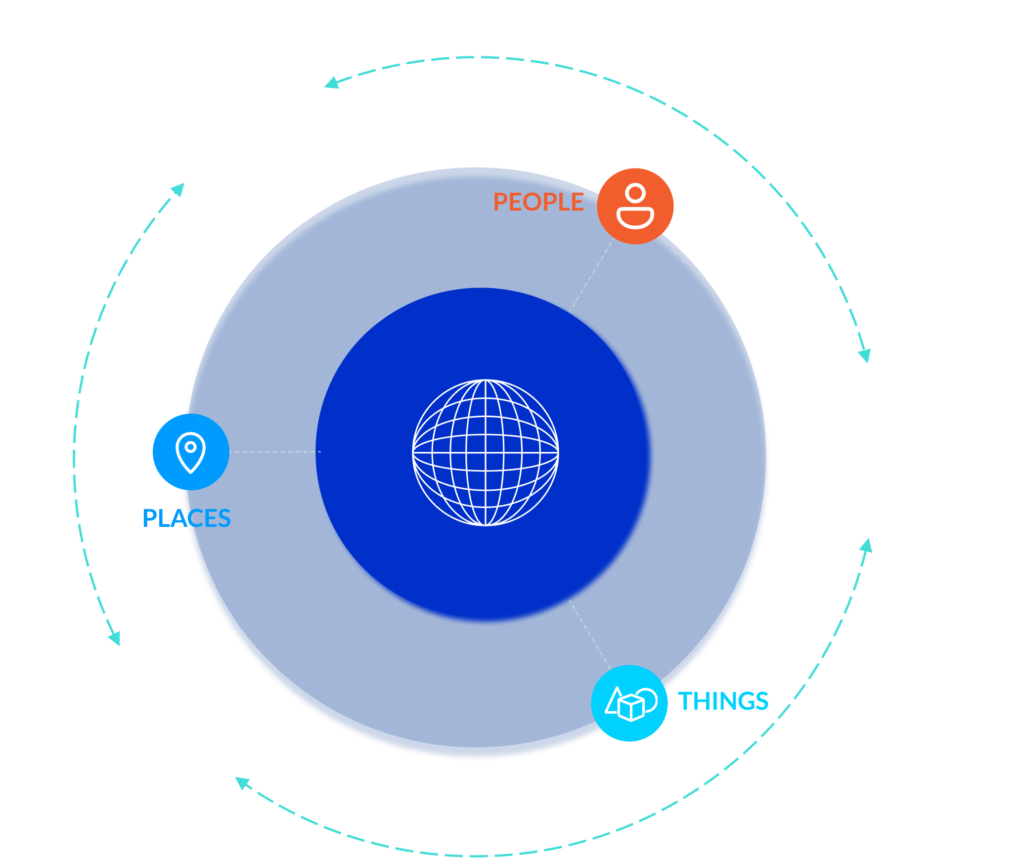
Define the entities, relationships and rules that describe your business. Occam uses this structured model to generate the core code across the operational system, including the screens people use and the connections other systems depend on. To speed onboarding, AI can help turn a plain-language business requirements document into the model. AI helps write the model. It never writes the code.
When requirements change, update the model and regenerate the affected components. The generated software and The Shield always work from the same definition of your business.
The Occam platform
Occam sits alongside the systems that already run your business. Bringing in data, adding context or adding new capability is comparatively fast and low cost, and existing systems can be retired when you’re ready, not on day one. It generates new capability from a model of your business and gives AI agents a governed path to act, without replacing what you have. For platform businesses, it can also reduce the engineering done for each customer. Judge it on one real workflow: inspect the generated outputs and agree what integration work remains.

Business definitions, relationships and rules live in one model that drives the generated system, so people, connected systems and AI agents all work from the same foundation. AI agents draw both data and its meaning from the generated system.
AI agents never act on your systems directly. Every action goes through The Shield, which checks it against the rules of your business, and only what passes is committed. The Shield is generated with the system from the same model, not configured separately.
Every proposal, refusal and commit is logged as part of the generated path, so you can show exactly what an agent attempted and what happened.
This replaces manual database design, ETL pipelines, and semantic layers with deterministic system generation.
Zero ETL
The pipeline is invisible and auto-generated from the ontology.
Zero Drift
Operational and analytical data are mathematically identical.
Zero Technical Debt
When business logic changes, the system recompiles instantly — no rewrites, no migrations.

Follow a rule into generated code, a working screen and The Shield: an allowed action, a refusal and the audit record. Then bring one of your workflows, and we’ll examine the outputs, the connections it needs and a practical measure of success.
You can also email us directly at info@occam.works
3 min read · Oct 08, 2025
Data 2.0 and the Pinch Point the Industry Can’t Escape
Steven MacLeod has a stark message: Data 2.0 is coming, and it will trigger one of the biggest structural shifts the industry has ever faced. Read on!
3 min read · Sept 29, 2025
Why We Need to Move to Data 2.0
At the recent DataEngBytes conference in Sydney, most of the 500 people in the room were talking about how to add agentic AI to their stack. Occam founder Steven MacLeod was one of the few who didn’t…
3 min read · Aug 20, 2025
At Last We Get to Talk About AI
Our final open letter to New Zealand’s Parliamentary Commissioner for the Environment addressing the proverbial elephant in the room — AI

An official TEAM Cloud Partner. Occam is listed in TEAM Cloud’s New Zealand partner network. View our partner listing →